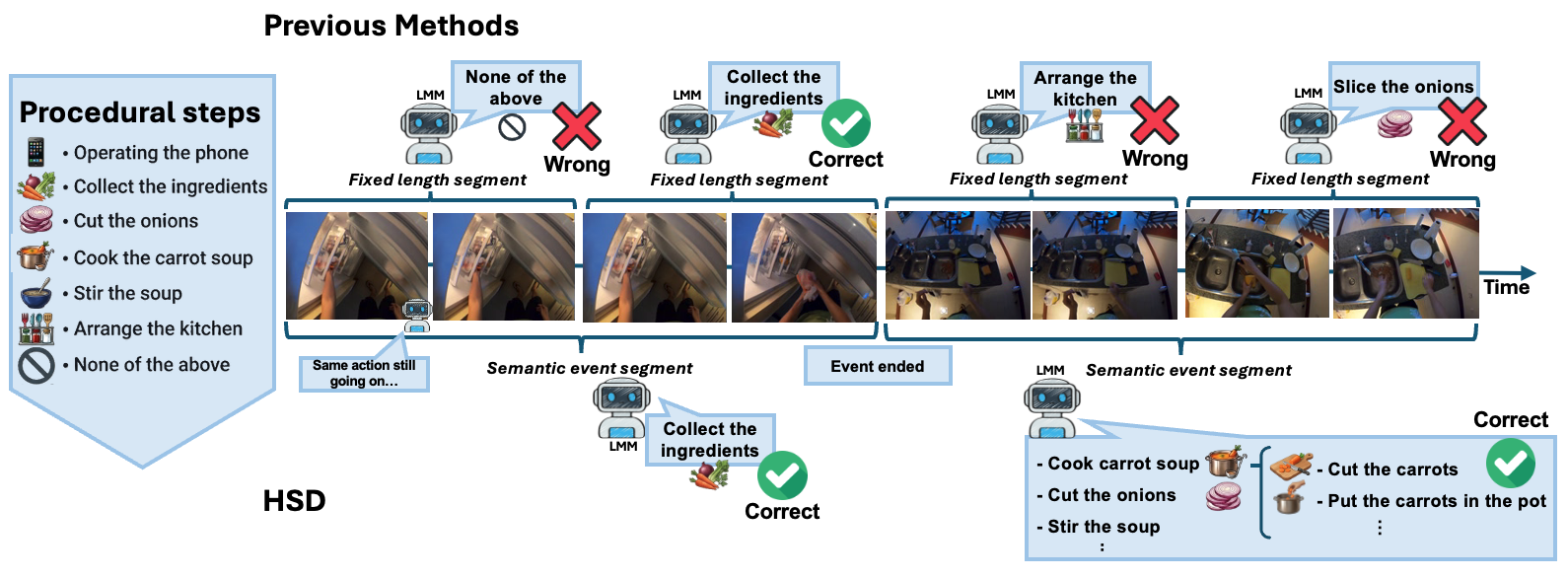
Top: previous online video step grounding predicts a procedural step for every fixed-length segment. Bottom: HSD constructs semantically coherent events from the stream and, when the step prediction is uncertain, decomposes candidate steps into substeps to close the granularity gap between coarse step descriptions and what is visible in the video.
Training-free and onlineOne frozen large multimodal model runs all three stages. No fine-tuning, no access to future frames.
+6.98 and +6.63 average mAPover the previous online state of the art on HT-Step and CrossTask with the same Qwen2.5-VL-7B backbone, and +6.42 R@1 on Ego4D Goal-Step.
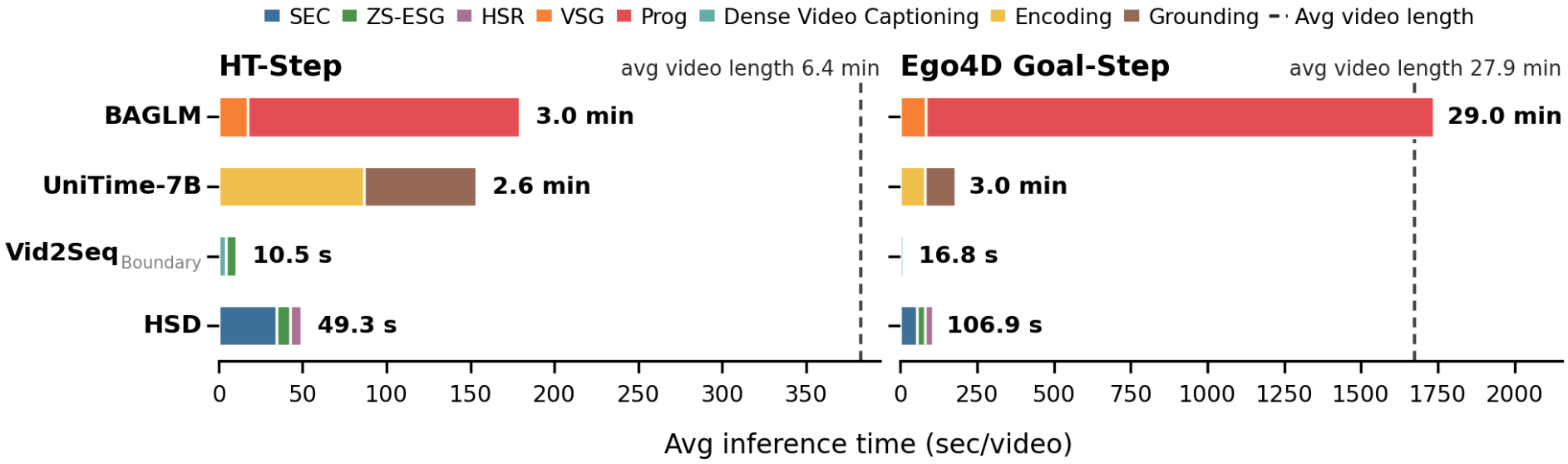
3× to 16× fasterper video than the previous online method, because grounding runs once per event rather than once per 2-second segment.
Abstract
Given a set of procedural steps, Video Step Grounding (VSG) aims to identify which steps occur in a video and localize when they are performed. Existing methods are either offline, requiring access to the full video before making predictions, or online, but relying on fixed-length video segments producing noisy, over-segmented outputs. In this work, we propose Hierarchical Step Decomposition (HSD), a training-free framework for online VSG that leverages the semantic understanding capabilities of Large Multimodal Models. HSD addresses two central challenges in online grounding: constructing semantically coherent temporal segments from a streaming video, and bridging the semantic gap between coarse procedural step descriptions and visual observations. To construct elementary temporal units, HSD incrementally groups incoming segments into semantically consistent events, using an anchor caption that is continuously validated against the visual stream. Based on these events, we perform zero-shot procedural step classification and selectively refine uncertain predictions by decomposing candidate steps into fine-grained substeps that capture more nuanced visual evidence. By operating on semantically coherent events rather than every fixed-length segment, HSD reduces redundant computation and produces more stable predictions. Experiments on HT-Step, Ego4D Goal-Step, and CrossTask show that HSD substantially outperforms state-of-the-art methods, overall achieving better step recognition, more accurate temporal localization, and faster inference.
Method
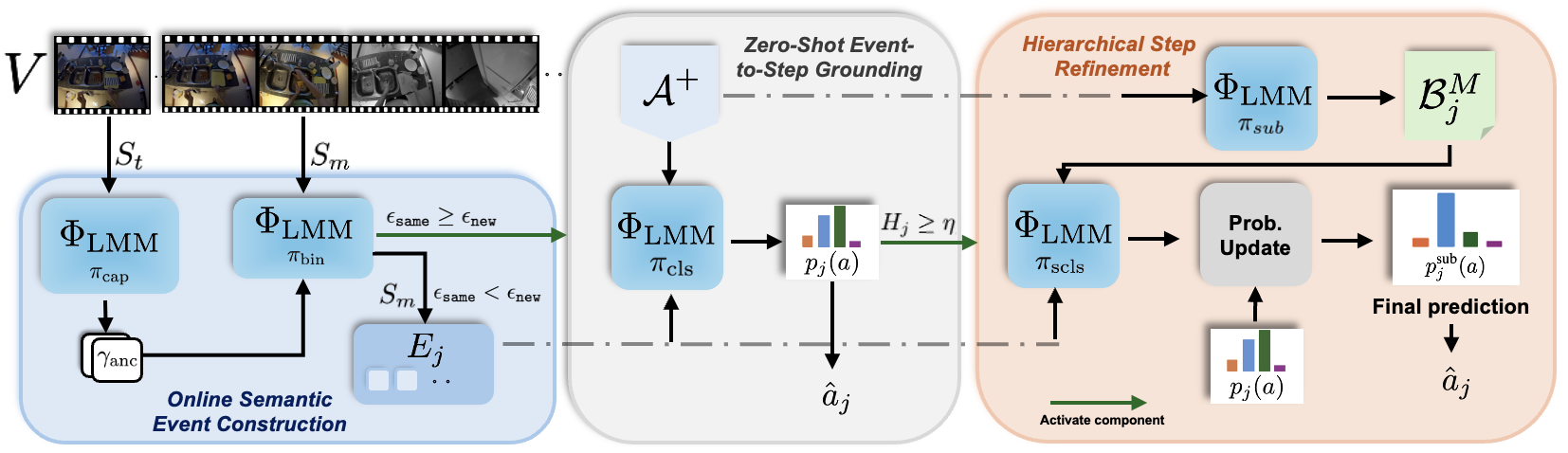
Given an input video, Online Semantic Event Construction builds each event from fixed-duration segments: the first segment is captioned, and every later segment is appended while the LMM judges it to be the same event rather than a new one. Each completed event goes through Zero-Shot Event-to-Step Grounding, which yields a distribution over the candidate steps. If its entropy is below a threshold, the most likely step is emitted; otherwise Hierarchical Step Refinement decomposes the top-k steps into substeps, re-evaluates the event, and aggregates substep scores back to the step space.
Stage 1
Online semantic event construction
The video arrives as non-overlapping 2-second segments. When an event starts, the LMM captions its first segment and that caption becomes the anchor. Each following segment is checked against the anchor with a single binary query, and it joins the event whenever the model's probability for same exceeds that for new. Events therefore stretch to the length of the underlying action without looking ahead.
Stage 2
Zero-shot event-to-step grounding
A completed event is scored with one multiple-choice prompt that lists the task, the candidate steps and a none of the above option. The next-token probabilities of the answer letters, normalized over the options, give the step distribution. Its argmax is the prediction, and its entropy decides whether refinement is needed.
Stage 3
Hierarchical step refinement
When the entropy is high, the top-k candidate steps are expanded into one to five atomic substeps, generated once per task by the same LMM. The event is re-scored over this finer pool, each parent step inherits the maximum of its substep scores, and the result is reweighted by the parent's initial probability so the fine-grained choice stays anchored to the procedural context.
Results
Online video step grounding on three benchmarks. HSD improves over every BAGLM variant with the same backbone and sets a new state of the art for online VSG. The paper's full table adds offline step-grounding methods, dense video captioning and temporal grounding models adapted to the task, and an oracle that grounds ground-truth segments.
Method
Backbone
HT-Stepavg mAP @ IoU 0.3–0.7
CrossTaskavg mAP @ IoU 0.3–0.7
Ego4D Goal-StepR@1, IoU 0.3
NaSVA-Online
–
6.30
7.27
7.07
BAGLM
InternVL2.5-8B
7.70
13.26
16.80
BAGLM
Qwen2.5-VL-7B
7.70
11.43
13.09
BAGLM
Qwen3-VL-8B
8.40
14.08
14.52
HSD (ours)
InternVL2.5-8B
13.15
18.80
20.33
HSD (ours)
Qwen2.5-VL-7B
14.68
18.06
19.51
HSD (ours)
Qwen3-VL-8B
15.13
22.43
25.36
mAP follows the HT-Step protocol, averaged over IoU thresholds 0.3 to 0.7. Ego4D Goal-Step uses its official Recall@1 at IoU 0.3. Bold marks the best online result. All methods use the same 2-second, 2-fps input stream.
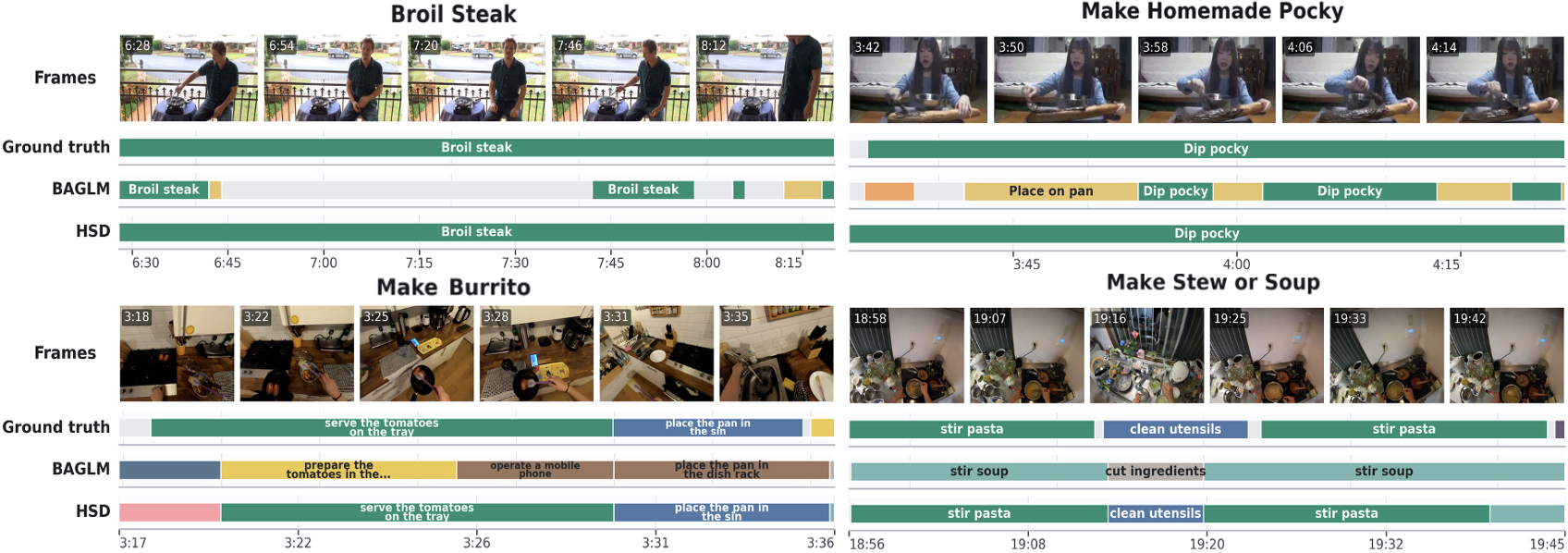
Inference time. Per-video processing time on HT-Step and Ego4D Goal-Step with Qwen2.5-VL-7B, compared with BAGLM, UniTime-7B and the boundary variant of Vid2Seq. HSD grounds each event once instead of every 2-second segment, so its advantage grows with video length: about 3× faster than BAGLM on HT-Step and up to 16× on the roughly 26-minute Ego4D Goal-Step videos.Qualitative comparison. BAGLM and HSD with Qwen2.5-VL-7B on four HT-Step videos. BAGLM interrupts the central broil steak action with None, confuses prepare tomato with serve tomato, and predicts place on pan in the Pocky video where a visible pan biases the fixed segment. Operating on coherent events removes these spurious cues. In Make Stew or Soup, the substeps rinse the utensil and move the pasta around with a spoon give the refinement stage the evidence to ground clean utensils and stir pasta, which the step descriptions alone confuse with neighbouring steps.
BibTeX
@inproceedings{zhou2027hsd,
  title     = {Hierarchical Step Decomposition for Training-free Online Video Step Grounding},
  author    = {Zhou, Long and Zanella, Luca and Rota, Paolo and Mancini, Massimiliano and Ricci, Elisa},
  booktitle = {Proceedings of the IEEE/CVF Winter Conference on Applications of Computer Vision (WACV)},
  year      = {2027}
}